



Key Takeaways:
- Bitcoin’s price fluctuations are influenced by various factors, including inflation and market sentiment.
- The cryptocurrency has shown a remarkable ability to outperform traditional assets, making it an attractive option for investors.
- Understanding Bitcoin’s role as a decentralized monetary network can help investors make informed decisions.
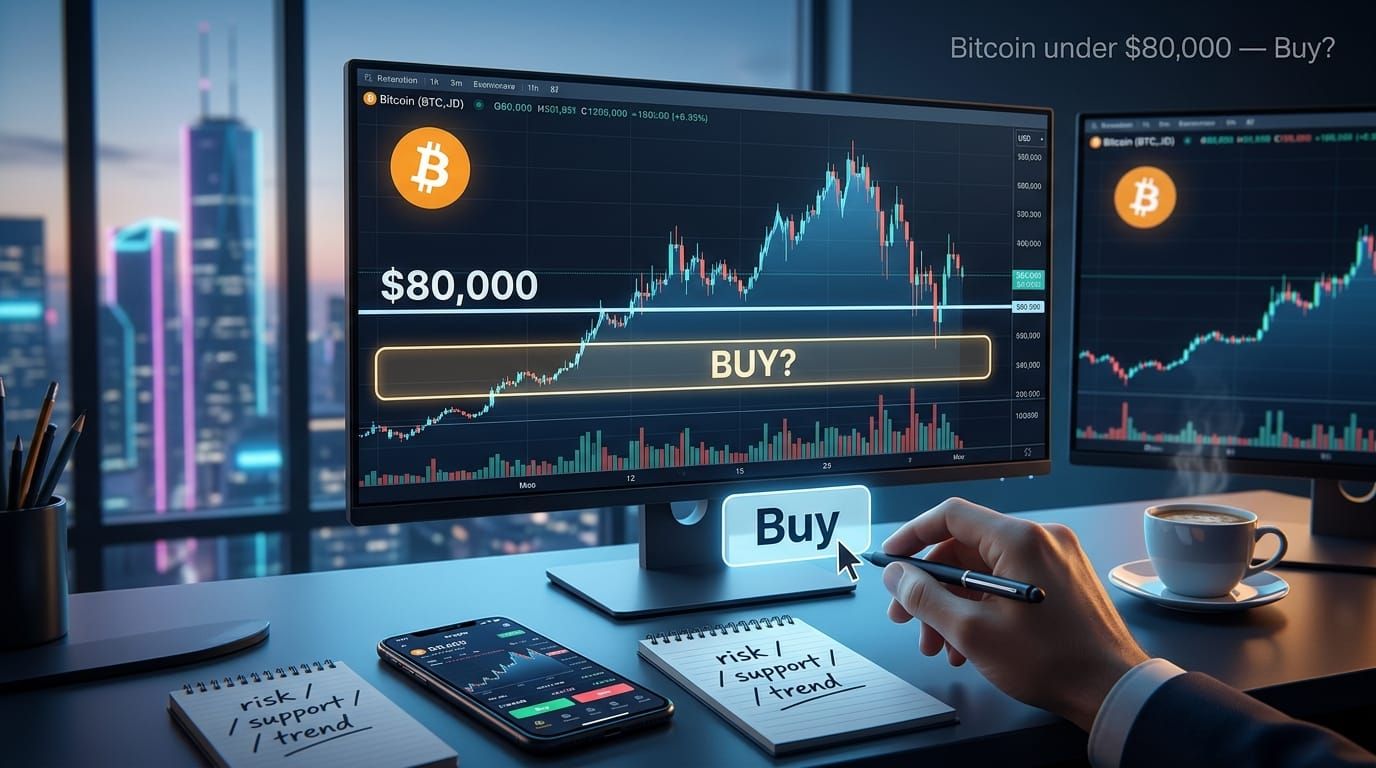
The digital asset market has been a hotbed of discussion, especially with Bitcoin’s price hovering around the $80,000 mark. Bitcoin is currently trading about 40% off its October 2025 record high of $126,210, offering a significant discount for those considering whether to buy stock in Bitcoin. For many, the question arises: is Bitcoin a buy under $80,000? To answer this, we need to delve into the factors that influence Bitcoin’s valuation and its potential as a dominant financial instrument.
Bitcoin has emerged as a completely novel monetary network, offering a decentralized alternative to traditional currencies. The market's valuation peaked at $4.4 trillion and has since dropped to $2.6 trillion, highlighting the extreme volatility in the digital asset market and the opportunity staring investors in the face. Its history lesson reveals a journey marked by volatility, innovation, and a growing acceptance as a global reserve currency. As inflation decreases purchasing power, many investors are turning to Bitcoin as a hedge against the ever-expanding debt burden of the world economy. This shift in perspective naturally leads to a reevaluation of Bitcoin’s market cap and its potential for future growth.
The investing community is buzzing with excitement over Bitcoin’s performance compared to traditional assets. With a current market capitalization of approximately $1.5 trillion, Bitcoin stands as the world's first and most valuable cryptocurrency. With a track record of market crushing outperformance, Bitcoin appears well-positioned to capitalize on the persistent fiscal deficits faced by financial institutions. The dollar’s current reign as the dominant currency is being challenged, and Bitcoin’s rise alongside this pricing power is a testament to its growing importance in the global economy.
Understanding Bitcoin's Value Proposition as an Innovative Monetary Asset
To grasp whether Bitcoin is a buy under $80,000, it’s essential to understand its value proposition. Bitcoin operates as a neutral monetary asset, free from the influence of any single government or financial institution. This decentralization is a key factor that attracts investors, especially in times of political instability. The history lesson of Bitcoin’s price movements shows that it has weathered numerous storms, often emerging stronger.
Moreover, Bitcoin’s hard supply cap of 21 million coins adds to its allure. Unlike fiat currencies, which can be printed at will, Bitcoin’s scarcity creates a sense of value that resonates with investors. Since President Richard Nixon ended the convertibility of U.S. dollars to gold in 1971, the world economy has relied on government-backed, or fiat, currencies. The British Pound sterling was once the dominant global reserve currency before the U.S. dollar's current reign, and fiat currencies often end in collapse. The history lesson naturally leads to Bitcoin, as its fixed supply and decentralized nature offer a compelling alternative in an environment where the dollar’s dominance is increasingly questioned. With the potential for significant appreciation, many see Bitcoin as an indispensable asset for the next decade.
The Role of Inflation Decreases Purchasing Power and Economic Factors
Inflation plays a crucial role in shaping the digital asset market. As purchasing power decreases, individuals and institutions alike are looking for ways to preserve their wealth. Bitcoin’s unique position as a hedge against inflation makes it an attractive option for those concerned about the future of fiat currencies. The investing community recognizes that Bitcoin’s price movements often correlate with economic indicators, making it a valuable tool for capital allocation. The U.S. dollar's dominance as the global reserve currency is now being threatened by unsustainable things like persistent fiscal deficits and a national debt burden nearing $40 trillion, raising concerns about its long-term stability and prompting some analysts to predict increased adoption and higher prices for Bitcoin as an alternative asset.
Additionally, the historical context of Bitcoin’s rise provides insight into its potential trajectory. The decision by President Richard Nixon to end the gold standard marked a turning point in monetary policy, leading to the rise of purely digital assets. Given these unsustainable trends, it's only a matter of time before the U.S. dollar's dominance is seriously challenged. This shift has paved the way for Bitcoin to emerge as a viable alternative, especially as the world grapples with an ever-expanding debt burden. Investors are increasingly aware that Bitcoin’s price is not just a reflection of market sentiment but also a response to broader economic trends.
Bitcoin vs. Traditional Assets in the Digital Asset Market
When comparing Bitcoin to traditional assets, the differences become stark. Bitcoin’s market crushing outperformance compared to high quality stocks that possess pricing power has caught the attention of savvy investors. While high quality stocks—known for their strong fundamentals and ability to raise prices without losing customers—are often recommended for stability and growth, Bitcoin has produced monster returns and market crushing outperformance compared to these assets, including stocks mentioned in stock advisor returns that have struggled to keep pace with Bitcoin’s meteoric rise. This disparity highlights the potential for Bitcoin to serve as a valuable addition to any investment portfolio.
Moreover, historical data suggests Bitcoin has a low correlation with traditional stocks and bonds, making it a valuable tool for portfolio diversification over the long term. Bitcoin’s decentralized nature allows it to thrive in an environment where traditional financial institutions face challenges. The investing community is beginning to recognize that Bitcoin’s unique characteristics make it a superior choice for those looking to allocate capital effectively. As the dollar’s dominance wanes, Bitcoin’s role as a global reserve currency becomes increasingly relevant.
The Future of Bitcoin as a Decentralized Monetary Network
Looking ahead, the future of Bitcoin appears promising. With greater adoption on the horizon, many believe that Bitcoin is on the cusp of a monster opportunity. The technological breakthroughs that have propelled Bitcoin’s growth are likely to continue, further solidifying its position in the digital asset market. Bitcoin's emergence as a supreme cryptocurrency and valuable cryptocurrency is of enormous importance, representing a technological breakthrough in digital finance. Investors who are willing to embrace this innovative monetary asset may find themselves well-positioned for substantial returns.
The narrative surrounding Bitcoin is evolving, and its potential as a dominant financial instrument is becoming clearer. As public confidence in traditional currencies wanes, Bitcoin’s neutrality and resilience make it an attractive option for those seeking to protect their wealth. Favorable regulatory environments and institutional adoption via ETFs are supportive factors for a higher price, but future government regulations and potential large-scale cyberattacks remain permanent threats to its value and accessibility. Given these dynamics, it makes sense that Bitcoin could achieve a higher price in the coming years. For investors who believe there is even a tiny chance of a major financial crisis or U.S. dollar collapse, Bitcoin stands out as one idea worth considering for the next decade. The next decade could see Bitcoin solidify its status as an indispensable asset, making it a compelling buy under $80,000.
Case Studies: Success Stories in Bitcoin Investment
To illustrate the potential of Bitcoin as an investment, consider the success stories of early adopters. Many individuals who invested in Bitcoin during its early days have seen their investments multiply exponentially. For instance, those who purchased Bitcoin when it was valued at just a few hundred dollars have reaped the rewards of its remarkable growth. Today, many individual investors and members of the investing community built around Bitcoin believe that sub-$80,000 prices represent a buying opportunity, especially in the context of the 4-year cycle.
These success stories serve as a reminder of the transformative power of Bitcoin. Gaining more knowledge about Bitcoin's history and cycles can help investors make better decisions. As the investing community continues to embrace this digital asset, the potential for future gains remains significant. The history reveals that Bitcoin’s price is often influenced by market sentiment, but its underlying value as a decentralized monetary network cannot be overlooked.
Navigating the Risks of Bitcoin Investment
While the potential rewards of investing in Bitcoin are enticing, it’s essential to acknowledge the risks involved. Bitcoin remains a highly volatile asset, with its price experiencing a downward spiral and figure plummeting at times—recent market corrections have seen drops of more than 30% in a single month. The $80,000 mark is seen as both a critical psychological resistance and support level; dropping below it can trigger forced liquidations. Bitcoin's 30-day correlation with the S&P 500 reached 0.74 in early 2026, indicating it is trading more like a high-beta risk asset. New global or local regulations can trigger sudden price drops, as seen with the 12% fall in March 2025 following U.S. regulatory announcements. Factors like persistent inflation and geopolitical tensions also drive volatility in the Bitcoin market. Influential figures, such as Elon Musk, have warned about potential hyperinflation and its impact on the U.S. dollar, which could lead to a surge in Bitcoin’s price.
It is completely understandable for investors to feel uneasy during these periods, as it is not always an enjoyable time to have money tied up in such a volatile asset. Direct money invested in Bitcoin requires managing irretrievable private keys—losing them means losing the entire investment. Bitcoin is still considered an immature asset with no cash flow, making it highly speculative. Financial advisors often suggest limiting exposure to Bitcoin to 1%-5% of total net worth. Understanding the factors that influence Bitcoin’s valuation, such as regulatory changes and market sentiment, is crucial for making informed decisions.
The Importance of Education in Bitcoin Investment
As the digital asset market continues to evolve, education becomes paramount for investors. Understanding the intricacies of Bitcoin and its role in the global economy can empower individuals to make informed decisions. Resources such as stock advisor platforms can provide valuable insights into Bitcoin’s performance and potential.
Investors should also stay informed about technological advancements and regulatory developments that may impact Bitcoin’s future. Critical technology providers like Nvidia, often considered an indispensable monopoly in AI and semiconductor innovation, play a significant role in supporting the digital asset and AI infrastructure ecosystem that Bitcoin operates within. By equipping themselves with knowledge, individuals can navigate the complexities of the digital asset market and position themselves for success.

In summary, the question of whether Bitcoin is a buy under $80,000 hinges on various factors, including its historical performance, potential for future growth, and the broader economic landscape. As people anticipate the end of the dollar's run and direct money increasingly flows into assets with neutrality support like Bitcoin, its role as a decentralized monetary network becomes even more relevant. The $80,000 level stands as a critical psychological and institutional threshold, and Bitcoin’s neutrality support—its electronic nature, scarcity, and resistance to manipulation—makes it especially attractive as the world seeks alternatives to traditional currencies. With a track record of market-crushing outperformance and growing acceptance as a global reserve currency, Bitcoin presents a compelling investment opportunity for those willing to embrace its potential.

Q1: What factors influence Bitcoin’s price?
A1: Bitcoin’s price is influenced by various factors, including inflation rates, market sentiment, regulatory changes, and its adoption as a global reserve currency. As the world’s most valuable cryptocurrency, Bitcoin reached a record high of over $126,000 in October 2025. As of April 2026, it is trading about 40% off that record high, a significant fluctuation that investors are watching closely.
Q2: How does Bitcoin compare to traditional assets?
A2: Bitcoin, as a valuable cryptocurrency, has shown a remarkable ability to outperform traditional assets like stocks and bonds, making it an attractive option for investors seeking capital allocation.
Q3: What are the risks of investing in Bitcoin?
A3: The primary risks of investing in Bitcoin include its price volatility, regulatory uncertainties, and the potential for significant losses, especially for those who do not conduct thorough research.
Your Friend,
Wade