




Key Takeaways
- From 2024 to 2034, data from the U.S. Bureau of Labor Statistics projects the healthcare sector will lead job growth, not shrink. Artificial intelligence will reshape certain tasks, not eliminate entire professions.
- Roles involving repetitive, data-intensive tasks-like medical billing, coding, and documentation-are highly susceptible to automation, while direct patient care positions remain human-led.
- AI can assist but not fully replace healthcare professionals. It struggles with complex clinical decision-making, empathy, and the kind of real-time judgment that nurses, doctors, and therapists provide daily.
- The biggest risk is not mass job displacement but a shift in how healthcare jobs are performed. Human workers who ignore AI tools may lose their competitive advantage in a rapidly evolving healthcare industry.
Introduction: Can AI Really Take Over Healthcare Jobs?
A decade ago, the idea that artificial intelligence could draft clinic notes, flag cancer on a chest X-ray, or handle patient intake felt like science fiction. In 2026, it is everyday reality in a growing number of healthcare systems. Headlines about AI replacing physicians and nurses have left many employees across the sector waiting for clarity on what comes next.
One in three workers fear AI will replace their jobs, according to recent surveys. Within healthcare specifically, that anxiety is rising fast. But does the hype match the evidence? This article walks through what AI is actually doing in the healthcare industry today, which roles face the most impact, and how professionals can effectively adapt rather than sit on the sidelines.
We are separating hype from fact, using real data, case studies, and regulatory context to determine what the future holds.

What Is Artificial Intelligence in Healthcare Today?
In practical terms, artificial intelligence in healthcare refers to software systems that learn from data to support tasks like diagnosis, triage, documentation, and workflow automation. AI requires extensive data input and training to function effectively-it does not "think" the way a clinician does.
Concrete examples are already widespread. As of late 2025, the FDA has cleared over 1,400 AI-enabled medical devices, with roughly 76% focused on radiology. AI tools are increasingly integrated into core clinical workflows, from ambient AI scribes that process physician-patient dialogue into draft notes, to decision-support systems embedded in electronic health records. AI enhances efficiency in clinical documentation and predictive analytics, helping clinicians predict patient risk scores and prioritize care.
It matters to understand that all current hospital AI is "narrow"-designed for a specific task. There is no general AI practicing medicine. Every deployed tool acts as a copilot, not an autonomous medical professional.
Will AI Replace Healthcare Workers or Just Parts of Their Jobs?
Professional bodies like the American Medical Association have consistently stated that AI is more likely to augment clinicians than to fully replace them this decade. The consensus is clear: AI can assist but not fully replace healthcare professionals, because healthcare involves far more than processing information.
The critical distinction is between task automation and job automation. AI can improve patient care efficiency by automating tasks like drafting discharge summaries, but it cannot act as the physician who explains a difficult diagnosis to a family. AI assists healthcare professionals in decision-making processes, but final accountability stays with the human.
Consider the numbers:
- The U.S. economy is projected to add 5.2 million jobs by 2034, with healthcare leading that growth.
- Healthcare support roles like home health aides are projected to grow by 15% over the decade.
- Registered nurses and medical assistants continue to be in high demand despite rising AI use.
Fully replacing a nurse, physician, or therapist would require reliable automation of manual skills, real-time ethical judgment, and communication with patients and families-capabilities no current technology can deliver safely.
Healthcare Jobs Most Likely to Be Transformed by AI
Some healthcare jobs face more exposure because their work is already digital, repetitive, and rule-based. These roles will not necessarily disappear, but the day-to-day process will change significantly.
Documentation and scribes. Medical scribes may soon be replaced by AI technology. Ambient AI scribes have already cut charting time in half in some settings-psychiatric providers using tools like Psynopsis reported 60–75% time savings in documentation, enabling 4–10 additional patient visits per week. AI can streamline administrative tasks in healthcare settings at scale.
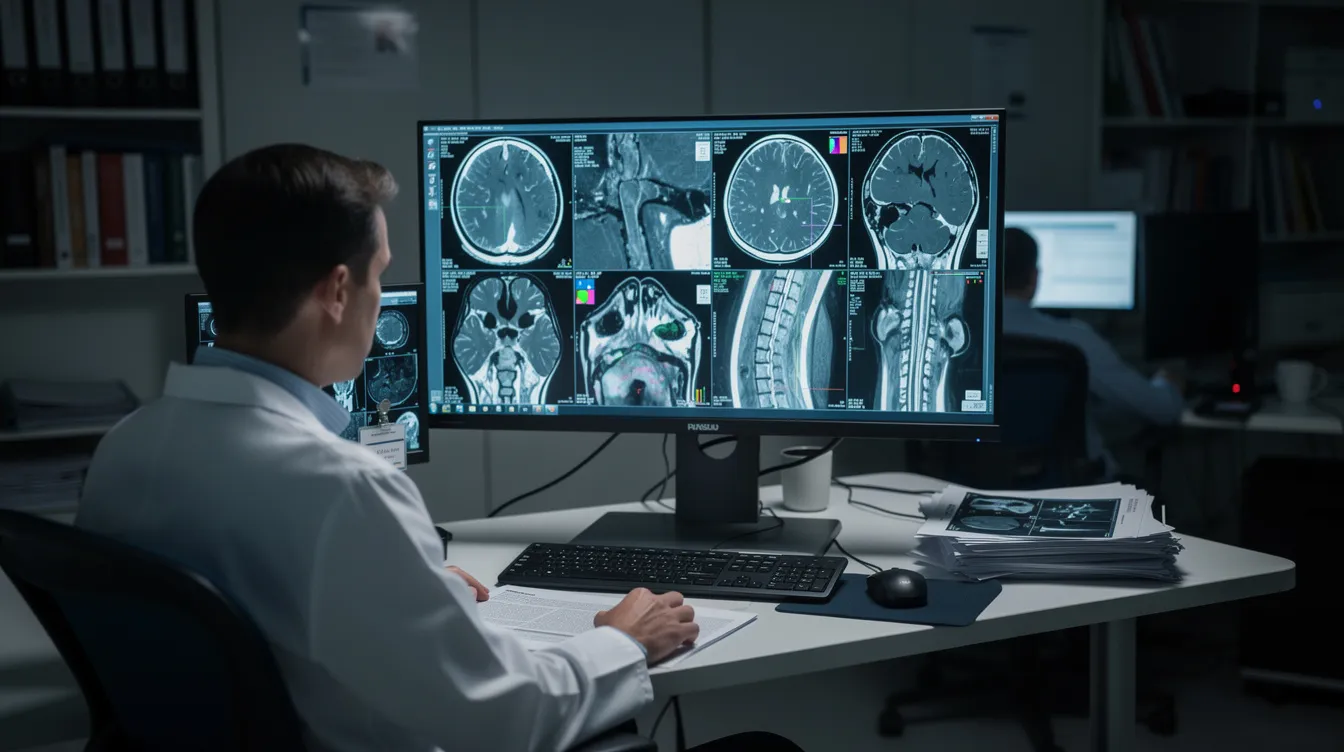
Radiology and pathology. AI can enhance diagnostic accuracy in radiology by pre-screening images, flagging urgent findings, and prioritizing worklists. Radiologists remain responsible for final reports and clinical judgment, but the tool reshapes how they spend their day.
Administrative and billing roles. Medical billers and coders are at risk of AI displacement as AI handles checking, prior authorization support, and appointment scheduling. AI chatbots are used for routine scheduling and patient intake tasks, handling high-volume interactions and escalating complex cases to human workers.
Pharmacy support. AI automates medication interaction checking and dosage alerts. However, pharmacists retain oversight for high-risk clinical decisions involving medications, safety, and law.
AI can also reduce supply chain costs by 10 to 20 percent across healthcare systems, affecting procurement and logistics roles.
Healthcare Jobs Least Likely to Be Fully Replaced by AI
Jobs involving hands-on care, empathy, and complex real-time problem-solving remain the most resilient. AI will not replace direct patient care healthcare workers-the evidence on this point is strong.
- Nurses, nurse aides, and home health aides perform physical care, emotional support, and on-the-spot prioritization in unpredictable situations. No bot or automated system can interact with a distressed patient, reposition them, or respond to a sudden drop in status the way a trained human can.
- Physicians in primary care, emergency medicine, surgery, and pediatrics rely on bedside communication, shared decision-making, and procedural skill. AI may lead to better decisions through decision support, but cannot replace the doctor who must determine a treatment path with a frightened patient.
- Allied health professionals-physical therapists, occupational therapists, respiratory therapists-deliver interventions requiring in-person assessment, motivation, and real-time adaptation. Their procedures demand human presence.
Even in these roles, daily tasks will change. Clinicians will increasingly verify AI-generated suggestions and integrate them into patient conversations.
Separating Hype from Reality: What AI Can and Cannot Do in Healthcare
Media narratives promising "AI doctors" or "robot nurses" are not grounded in how healthcare actually operates. The reality is more nuanced and less dramatic.
Key limitations in 2026 include:
- Data bias. A study from MIT showed that image-based diagnostic models sometimes encode patient race or gender, performing worse across underrepresented groups. AI's effectiveness is limited by the quality of input data.
- Explainability. Many models function as a "black box," making it difficult to understand why a recommendation was made-a serious concern in a business where every diagnosis carries life-or-death weight.
- AI struggles with complex clinical decision-making processes. Rare conditions, multi-system diseases, and nuanced patient histories routinely trip up even the best models.
- Regulatory constraints. The FDA, EMA, and national data protection agencies approve AI only as decision support. AI cannot fully replace human oversight in healthcare tasks. A licensed clinician must review and sign every diagnosis.
Wise healthcare leaders treat AI as powerful infrastructure that needs governance-not a magic replacement for their workforce.
Security verification processes and security service protocols around AI in healthcare are evolving. Just as a website verifies that a visitor is not one of many malicious bots before granting access-where verification successful means the respond ray id confirms legitimacy-healthcare systems must verify that AI outputs are accurate before they reach patients.
How Healthcare Professionals Can Work With AI, Not Against It
AI literacy is becoming a core career skill for every healthcare worker, not just data scientists or a CEO in a boardroom.
Here is how to stay ahead:
- Learn how AI tools work. Understand what data they use, where they fail, and how to safely question outputs. Healthcare professionals will need to master data analysis to remain competitive.
- Use AI for time-consuming tasks. Drafting notes, summarizing long records, creating patient handouts. AI shifts the focus of healthcare workers to validation and interpretation roles, freeing time for direct care.
- Build human skills AI cannot replicate. Complex communication, interprofessional teamwork, ethical reasoning, and leadership in quality improvement give you an advantage no algorithm can match.
- Participate in implementation projects. Workers who join pilot programs and feedback loops position themselves for emerging roles like "clinical AI champion" or "digital transformation lead." AI is transforming administrative tasks into broader patient advocacy roles.
The point is not to compete with AI but to become more productive by working alongside it.

Risks, Ethics, and Job Security Concerns Around AI in Healthcare
Real anxieties about job displacement, surveillance, and pace of change exist among healthcare workers, and dismissing those concerns does no one any favors.
- Algorithmic bias can widen health inequalities if models are trained on narrow datasets. Patients with cancer, rare diseases, or underrepresented backgrounds may receive lower-quality recommendations.
- AI faces challenges with patient privacy and healthcare regulations. Tools that transcribe physician-patient conversations raise questions about consent, storage, and compliance with HIPAA and GDPR. Protecting this data is a matter of both law and trust.
- Over-reliance. If employees and society treat AI as infallible, critical errors-wrong dosage, missed diagnosis-become more likely. Every system verifies outputs, but only if someone is checking.
- Staffing pressure. If management uses productivity gains from AI to push workloads up without safeguards, patient safety and morale may suffer. The money saved should not come at the cost of care quality.
Institutions can protect their workforce and patients by involving staff in tool selection, providing retraining paths, and setting clear guidelines on when humans can override AI.

Looking Ahead: The Future of AI and Healthcare Jobs by 2030 and Beyond
The next five to ten years will bring steady integration, not sudden replacement. Expect AI embedded in every major hospital system by 2030: automated pre-visit questionnaires, AI triage routing, and continuous monitoring alerts across inpatient wards.
New roles will emerge. Clinical data stewards, AI safety officers, prompt specialists for clinical documentation, and hybrid clinician-informatician careers are already appearing. Decades from now, the healthcare workforce will look different-but it will still be deeply human.
Educational programs for nurses, physicians, and allied health professionals will increasingly include modules on AI literacy, data ethics, and digital health workflows. Advancements in technology will reshape curricula across society, not just in medicine.
For anyone entering healthcare or struggling to see their path forward: choose pathways that combine patient-facing skills with comfort using digital tools. That combination is your best protection against whatever comes next, and it positions you to deliver services that patients and healthcare systems will always need.

FAQ: Common Questions About AI and Healthcare Jobs
Will AI reduce the number of doctors and nurses needed in hospitals?
Most forecasts through at least 2034 still show shortages of physicians and nurses in many countries, especially those with aging populations. AI can reduce administrative burden and help clinicians work more efficiently, but it will not eliminate the need for human caregivers. The healthcare industry employs nearly 18 million people in the U.S. alone, and that number is projected to grow.
What healthcare job is most likely to be heavily automated first?
Documentation-heavy and back-office roles are already seeing strong AI automation. Medical scribes, parts of medical billing and coding, and some call-center triage tasks are the clearest early examples. Roles involving repetitive data-intensive tasks are highly susceptible to automation, with human workers shifting toward oversight and exception handling.
Can a hospital legally let an AI system make diagnoses without a clinician?
In most jurisdictions in 2026, AI tools are approved only as decision support. A licensed clinician must review and take responsibility for final diagnoses and treatment plans. Fully autonomous AI diagnosing without human oversight remains generally unapproved.
How can students preparing for healthcare careers future-proof themselves against AI changes?
Build strong clinical foundations and develop comfort with digital tools. Seek exposure to informatics or data science modules during your education. Practice communication and teamwork skills that are hard for AI to replicate. Understanding how AI works-and where its limitations lie-will give you a lasting advantage in achieving long-term career resilience.
Is it safe for patients to trust AI tools they see online for medical advice?
Publicly available AI chatbots are not a substitute for professional medical care. They may not have access to full medical histories, and their outputs can contain errors or hallucinations. Use them for general information only, and direct any serious health concerns to licensed healthcare providers who can properly evaluate your situation.
Your Friend,
Wade