



Key Takeaways:
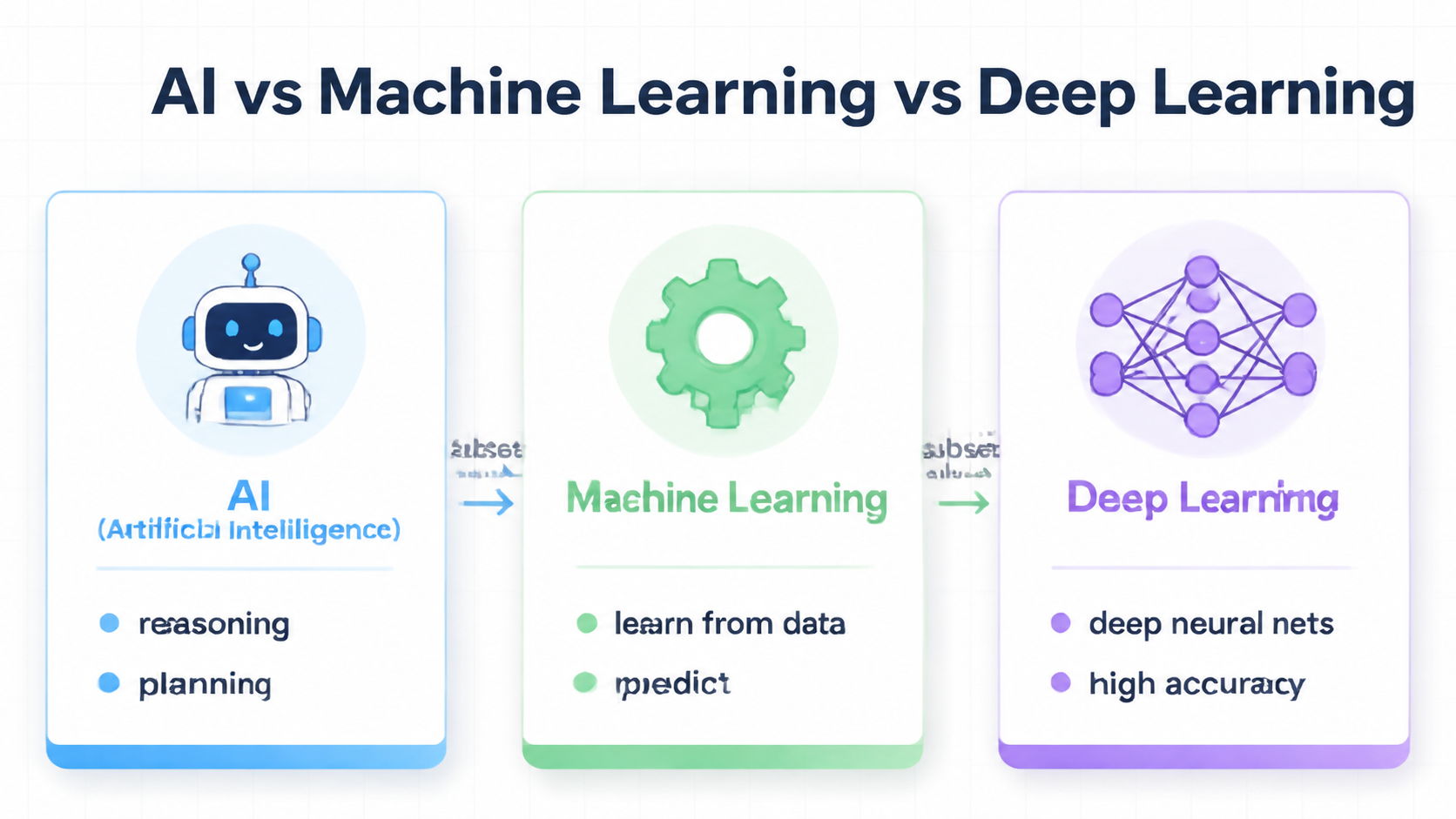
- Hierarchy of Concepts: Artificial Intelligence (AI) encompasses both Machine Learning (ML) and Deep Learning (DL), with ML being a subset of AI and DL a subset of ML.
- Learning Techniques: Machine Learning uses algorithms to analyze data and make predictions, while Deep Learning employs neural networks with multiple layers to process vast amounts of unstructured data.
- Applications: Both ML and DL have unique applications, from fraud detection to self-driving cars, but DL is particularly effective in tasks requiring high-level abstraction, such as image and speech recognition.
Understanding Artificial Intelligence
Artificial Intelligence (AI) is the umbrella term that refers to the simulation of human intelligence in machines. These intelligent systems are designed to perform tasks that typically require human cognition, such as problem-solving, understanding natural language, and recognizing patterns. Think of AI as the brain of a computer program, enabling it to think and act like a human.
AI can be broken down into various categories, including rule-based systems, expert systems, and the more advanced forms like Machine Learning and Deep Learning. Each category serves a different purpose, but they all share the common goal of making machines smarter and more efficient.
What is Machine Learning?
Machine Learning (ML) is a subset of AI that focuses on the development of algorithms that allow computers to learn from and make predictions based on data. Instead of being explicitly programmed to perform specific tasks, ML systems use statistical techniques to identify patterns and improve their performance over time.
For instance, a machine learning model can analyze historical data to predict future trends, such as stock prices or customer behavior. This ability to learn from data makes ML a powerful tool in various fields, including finance, healthcare, and marketing.
The Role of Deep Learning
Deep Learning (DL) is a specialized area within Machine Learning that employs artificial neural networks to process data. These networks consist of multiple layers of interconnected nodes, mimicking the way the human brain operates. The more layers a neural network has, the more complex patterns it can identify.
Deep Learning excels in handling unstructured data, such as images, audio, and text. For example, convolutional neural networks (CNNs) are commonly used in image recognition tasks, while recurrent neural networks (RNNs) are effective for natural language processing. This capability allows DL models to perform tasks that were once thought to require human intelligence.
Key Differences Between AI, ML, and DL
The primary distinction between AI, ML, and DL lies in their scope and functionality. AI is the broadest concept, encompassing any technique that enables machines to mimic human behavior. Machine Learning narrows this focus to algorithms that learn from data, while Deep Learning further refines it to neural networks that can learn from vast amounts of unstructured data.
To illustrate, consider a virtual assistant like Siri. The AI behind Siri uses ML algorithms to understand user commands and improve its responses over time. However, the speech recognition feature relies on Deep Learning to accurately interpret and process spoken language.
Machine Learning Algorithms
Machine Learning employs various algorithms to analyze data and make predictions. These algorithms can be categorized into supervised learning, unsupervised learning, and reinforcement learning.
In supervised learning, the model is trained on labeled data, meaning the input data is paired with the correct output. For example, a machine learning model might be trained to recognize images of cats and dogs using a dataset that includes labeled images. In contrast, unsupervised learning deals with unlabeled data, allowing the model to identify patterns without prior knowledge of the outcomes.
Deep Learning Algorithms
Deep Learning algorithms, on the other hand, utilize artificial neural networks to process data through multiple layers. These layers enable the model to learn increasingly abstract features of the data. For instance, in image recognition, the first layer might detect edges, while subsequent layers identify shapes and eventually recognize objects.
Generative adversarial networks (GANs) are a popular type of deep learning algorithm that can generate new data based on existing datasets. This technique has been used in various applications, from creating realistic images to generating music.
The Learning Process in Machine Learning
The learning process in Machine Learning involves training a model on a dataset, allowing it to learn from the data and make predictions. This process typically includes several steps: data collection, data preprocessing, model selection, training, and evaluation.
During training, the model adjusts its parameters based on the input data and the corresponding outputs. The goal is to minimize the error between the predicted and actual outcomes. Once trained, the model can be tested on new data to evaluate its performance and accuracy.
The Learning Process in Deep Learning
Deep Learning models undergo a similar learning process, but with a focus on neural networks. The training of a deep learning model requires a significant amount of data and computational power, as the model learns through multiple layers of abstraction.
The training process involves feeding the model raw data, such as images or text, and adjusting the weights of the connections between neurons based on the output. This iterative process continues until the model achieves a satisfactory level of accuracy.
Applications of Machine Learning
Machine Learning has a wide range of applications across various industries. In finance, ML algorithms are used for fraud detection by analyzing transaction patterns and identifying anomalies. In healthcare, machine learning models can predict patient outcomes based on historical data, improving treatment plans and patient care.
Additionally, ML is widely used in marketing to analyze consumer behavior and optimize advertising strategies. By leveraging data, businesses can create targeted campaigns that resonate with their audience, ultimately driving sales and customer engagement.
Applications of Deep Learning
Deep Learning has revolutionized several fields, particularly those involving complex data types. In computer vision, deep learning models are used for image recognition, enabling applications like facial recognition and autonomous vehicles. Self-driving cars rely on deep learning algorithms to process real-time data from sensors and cameras, allowing them to navigate safely.
In natural language processing, deep learning models power virtual assistants and chatbots, enabling them to understand and respond to human language. This technology has transformed customer service, making it more efficient and accessible.
The Importance of Data in Machine Learning
Data is the lifeblood of Machine Learning. The quality and quantity of training data directly impact the performance of machine learning models. High-quality, labeled data allows models to learn effectively, while poor-quality data can lead to inaccurate predictions.
Data scientists often spend a significant amount of time cleaning and preprocessing data to ensure it is suitable for training. This process may involve removing duplicates, handling missing values, and normalizing data to improve model performance.
The Importance of Data in Deep Learning
In Deep Learning, the need for data is even more pronounced. Deep learning models typically require vast amounts of training data to achieve high accuracy. This is because the multiple layers of a neural network need diverse examples to learn complex patterns effectively.
Moreover, deep learning models can benefit from raw, unstructured data, allowing them to learn directly from the data without extensive preprocessing. This capability enables deep learning to excel in tasks like image and speech recognition, where traditional machine learning techniques may struggle.
Supervised vs. Unsupervised Learning
Supervised learning and unsupervised learning are two fundamental approaches in Machine Learning. In supervised learning, the model is trained on labeled data, allowing it to learn the relationship between inputs and outputs. This approach is commonly used in applications like spam detection and credit scoring.
Conversely, unsupervised learning involves training a model on unlabeled data, enabling it to identify patterns and group similar data points. This technique is often used in clustering applications, such as customer segmentation and anomaly detection.
Reinforcement Learning
Reinforcement Learning (RL) is another approach within the Machine Learning framework. In RL, an agent learns to make decisions by interacting with an environment and receiving feedback in the form of rewards or penalties. This trial-and-error learning process allows the agent to optimize its actions over time.
Reinforcement learning has gained popularity in applications like game playing and robotics. For instance, RL algorithms have been used to train AI agents to play complex games like Go and chess, achieving superhuman performance.
The Role of Human Intelligence
While AI, Machine Learning, and Deep Learning aim to replicate human intelligence, they still require human input for training and refinement. Human intelligence plays a crucial role in curating training data, selecting appropriate algorithms, and interpreting model outputs.
Moreover, human intervention is often necessary to ensure ethical considerations are addressed, particularly in sensitive applications like healthcare and finance. As AI systems become more advanced, the collaboration between human intelligence and machine intelligence will be essential for responsible development.
Challenges in Machine Learning
Despite its potential, Machine Learning faces several challenges. One significant issue is the risk of overfitting, where a model learns the training data too well and fails to generalize to new data. This can lead to poor performance in real-world applications.
Additionally, the reliance on high-quality data can be a double-edged sword. In many cases, obtaining labeled data is time-consuming and expensive, limiting the effectiveness of machine learning models. Data scientists must navigate these challenges to develop robust and reliable systems.
Challenges in Deep Learning
Deep Learning also presents its own set of challenges. The need for large amounts of data and computational power can be a barrier to entry for many organizations. Training deep learning models often requires specialized hardware, such as GPUs, which can be costly.
Furthermore, deep learning models can be difficult to interpret, making it challenging to understand how they arrive at specific decisions. This lack of transparency can raise concerns in applications where accountability is crucial, such as healthcare and finance.
Future Trends in AI, ML, and DL
The future of AI, Machine Learning, and Deep Learning is promising, with ongoing advancements in technology and research. As computational power continues to grow, we can expect more sophisticated models capable of tackling complex problems.
Additionally, the integration of AI with other emerging technologies, such as the Internet of Things (IoT) and blockchain, will open new avenues for innovation. These developments will likely lead to more intelligent systems that can adapt and learn in real-time.

Summary
In summary, the differences between AI, Machine Learning, and Deep Learning are rooted in their scope and functionality. AI serves as the overarching concept, while Machine Learning focuses on algorithms that learn from data, and Deep Learning employs neural networks to process complex data types. Each has its unique applications and challenges, but together they represent the cutting edge of technology, driving advancements across various industries.

Q1: What is the main difference between Machine Learning and Deep Learning?
A1: The primary difference lies in their approach to data processing. Machine Learning uses algorithms to analyze structured data, while Deep Learning employs neural networks with multiple layers to process unstructured data, allowing for more complex pattern recognition.
Q2: Can Deep Learning be used for supervised learning?
A2: Yes, Deep Learning can be applied in supervised learning scenarios. In this case, the model is trained on labeled data, allowing it to learn the relationship between inputs and outputs, similar to traditional Machine Learning techniques.
Q3: How does human intelligence contribute to AI development?
A3: Human intelligence plays a crucial role in AI development by curating training data, selecting appropriate algorithms, and interpreting model outputs. Additionally, ethical considerations require human intervention to ensure responsible AI deployment.
Your Friend,
Wade