



Introduction to Artificial Intelligence AI
Artificial Intelligence (AI) is the science and engineering of creating computer systems capable of performing tasks that would normally require human intelligence. These tasks include learning from experience, solving complex problems, recognizing patterns, and making informed decisions. AI systems rely on sophisticated algorithms and vast amounts of data to analyze information, predict outcomes, and generate insights that can rival or even surpass human capabilities in specific tasks.
The field of artificial intelligence has seen explosive growth in recent years, with AI models now powering everything from voice assistants and recommendation engines to self-driving cars and advanced medical diagnostics. By mimicking aspects of human intelligence, AI is transforming industries such as healthcare, finance, transportation, and education, enabling organizations to automate processes, improve efficiency, and unlock new opportunities.
However, as artificial intelligence AI becomes increasingly capable and integrated into our daily lives, it is crucial to recognize both its immense potential and the significant risks it poses. Understanding how AI systems operate, and the ways in which they impact decision making, is essential for harnessing their benefits while safeguarding against unintended consequences.
Key Takeaways:
- AI systems can perpetuate biases and lead to significant ethical dilemmas.
- The rapid evolution of AI technologies poses security risks and challenges in governance.
- Human oversight is crucial to mitigate the dangers associated with AI applications.
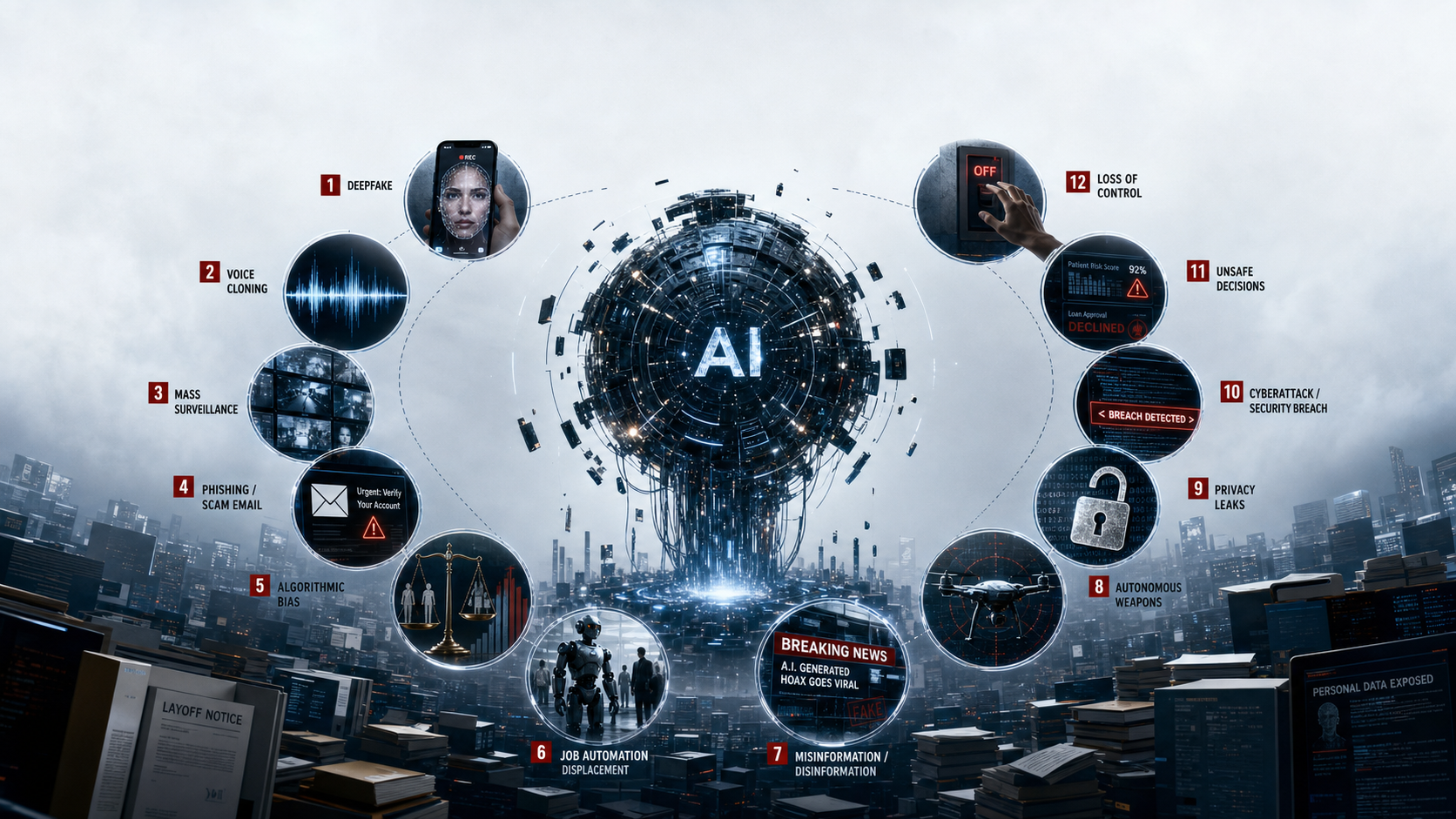
Artificial Intelligence (AI) has become a buzzword in recent years, capturing the imagination of tech enthusiasts and the general public alike. From self-driving cars to voice assistants, AI is transforming how we live and work. However, as we embrace these advancements, it's essential to shine a light on the risks and dangers that accompany them. This article delves into twelve critical risks associated with AI, exploring how they impact society, businesses, and individuals.
1. Bias in AI Algorithms
AI algorithms are only as good as the data they are trained on. If the training data contains biases, the AI outputs will reflect those biases, leading to unfair treatment of certain groups. The quality and integrity of data sets used in AI model training and validation are crucial—maintaining data integrity, performing anomaly detection, and conducting audits help prevent bias and ensure data quality. For instance, facial recognition technology has been shown to misidentify people of color at a higher rate than white individuals. This bias can have real-world consequences, such as wrongful arrests or discrimination in hiring practices. Bias in AI isn't just a technical glitch; it has real-life implications for hiring decisions, loan approvals, healthcare diagnoses, and more, potentially reinforcing social and economic inequities.
Moreover, biased algorithms can perpetuate stereotypes and reinforce societal inequalities. As AI systems become more integrated into decision-making processes, the stakes get higher. Companies must prioritize fairness in their AI models to avoid significant harm to marginalized communities.
2. Data Privacy Concerns
AI companies often collect vast amounts of personal data to train their models. This data collection raises significant privacy concerns, as sensitive information can be misused or exposed in data breaches. Monitoring for security incidents and ensuring rapid incident response are crucial to protect AI systems from breaches that could lead to the leak of personal data, putting individuals at risk of identity theft or fraud.
Furthermore, the lack of transparency in how data is collected and used can erode trust between consumers and AI companies. As people become more aware of these risks, they may hesitate to engage with AI tools, limiting the technology’s potential benefits. In fact, a Pew Research Center survey found that 79 percent of Americans are concerned about how companies handle their data, highlighting the growing awareness of data privacy issues.
3. Security Risks of AI Systems
AI systems are not immune to cyberattacks. Malicious actors can exploit vulnerabilities in AI algorithms to manipulate outputs or gain unauthorized access to sensitive information. For instance, adversarial attacks can trick AI models into making incorrect predictions, which can have dire consequences in critical applications like healthcare or autonomous vehicles.
The security risks associated with AI extend beyond individual systems. A compromised AI-driven system could lead to widespread disruptions, affecting everything from financial markets to national security. As AI continues to evolve, ensuring robust security measures is paramount.
4. Over-Reliance on AI
As AI tools become more prevalent, there's a growing concern about over-reliance on these technologies. While AI can enhance decision-making, it should not replace human judgment entirely. For example, in healthcare, relying solely on AI for diagnosis could lead to misdiagnoses if the model lacks context or understanding of a patient's unique situation.
This over-reliance can also stifle critical thinking and problem-solving skills. When individuals defer too much to AI outputs, they may miss opportunities for innovation or fail to recognize potential pitfalls. Balancing AI assistance with human oversight is crucial for effective decision-making.
5. Ethical Dilemmas in AI Development
The development of AI raises numerous ethical dilemmas that society must address. For instance, the use of AI in autonomous weapons poses significant moral questions about accountability and the value of human life. If an AI system makes a decision that leads to loss of life, who is responsible? It is crucial to acknowledge all these risks when advancing AI technology.
Additionally, the deployment of AI in surveillance raises concerns about privacy and civil liberties. As governments and corporations increasingly use AI for monitoring, the potential for abuse grows. Establishing ethical guidelines for AI development is essential to navigate these complex issues. Ethical considerations lie at the heart of responsible AI use, as relying solely on algorithmic decisions can lead to dehumanizing outcomes when emotional intelligence and cultural sensitivity are crucial.
6. Environmental Impact of AI
The energy consumption associated with AI workloads is another significant concern. Training large AI models requires vast amounts of computational power, leading to increased energy usage and a larger carbon footprint. For instance, the data centers that host AI applications consume substantial electricity, contributing to environmental degradation.
As the demand for AI continues to rise, so does the need for sustainable practices in AI development. Companies must consider the environmental impact of their AI initiatives and explore ways to improve energy efficiency.
7. Intellectual Property Issues
AI’s ability to generate content raises questions about intellectual property rights. For example, generative AI can create images, music, or text that may infringe on existing copyrights. There is also a risk of exposing trade secrets and proprietary information during AI training or content generation, which can lead to unauthorized access or replication of confidential data.
Generative AI tools can use millions of copyrighted works for inspiration without credit, raising concerns about plagiarism and unfair compensation for artists and writers.
Moreover, the potential for AI to clone voices or replicate artistic styles complicates the landscape further. As AI continues to evolve, establishing clear guidelines for intellectual property in the context of AI-generated content is crucial to protect creators’ rights. Intellectual property laws are not fully adapted to the unique capabilities of AI, leading to unresolved legal and ethical issues that could stifle creativity and result in complex lawsuits.
8. Spread of Misinformation
AI technologies can be weaponized to spread misinformation and fake news. With the ability to generate realistic text and images, bad actors can create convincing but false narratives that mislead the public. This poses a significant threat to democracy and informed decision-making.
For instance, during elections, AI-generated content can manipulate public opinion and sway votes. Combating this issue requires collaboration between tech companies, governments, and civil society to develop strategies for identifying and mitigating the spread of misinformation.
9. Security Vulnerabilities in AI Applications
Many AI applications, such as facial recognition and autonomous vehicles, are susceptible to security vulnerabilities. Hackers can exploit these weaknesses to gain control over systems or manipulate their behavior. For example, a compromised self-driving car could be directed to behave erratically, endangering passengers and pedestrians alike.
Addressing these vulnerabilities is critical to ensuring the safety and reliability of AI applications. Developers must prioritize security throughout the AI lifecycle, from data collection to deployment.
10. Job Displacement Due to AI Automation
AI automation poses a significant risk to the job market. As AI systems become capable of performing tasks traditionally done by humans, many workers may find themselves displaced. For instance, AI-driven systems can handle data entry, customer service, and even complex decision-making, leading to job losses in various sectors.
While AI can create new job opportunities, the transition may not be smooth for everyone. Workers must be equipped with the skills needed to thrive in an AI-driven economy, emphasizing the importance of education and retraining programs.
11. Challenges in AI Governance
The rapid evolution of AI technologies presents challenges in governance and regulation. Policymakers struggle to keep pace with advancements, leading to gaps in oversight. Without effective governance, AI systems may operate without accountability, increasing the risks associated with their deployment.
Establishing frameworks for AI governance is essential to ensure responsible development and deployment. Collaboration between governments, industry leaders, and researchers can help create guidelines that prioritize safety, ethics, and transparency.
12. The Threat of Autonomous Weapons
The development of autonomous weapons raises profound ethical and security concerns. These AI-driven systems can make life-and-death decisions without human intervention, leading to potential misuse and unintended consequences. The threats posed by such technologies include the possibility of job automation, fake news, and especially AI-powered weaponry, which amplify the dangers and highlight the importance of understanding and managing AI risks. Military and defense organizations worldwide are actively researching AI-driven weaponry, including drones capable of independent decision-making and robotic soldiers. Some countries have already deployed semiautonomous defensive systems, raising ethical concerns about whether AI-guided weapons can make lethal decisions without human oversight. Human Rights Watch and other NGOs have called for bans on fully autonomous weapons, citing ethical and moral hazards associated with their use. The development of lethal autonomous weapon systems (LAWS) has sparked fears of a global arms race, as major military powers invest in AI weapon technology. Additional concerns include the potential for malfunctioning or hacking of autonomous weapons, which could escalate conflicts and endanger civilians. The prospect of AI in warfare challenges traditional notions of accountability and responsibility.
As nations race to develop advanced military technologies, the need for international agreements on the use of AI in warfare becomes increasingly urgent. Establishing norms and regulations can help mitigate the risks associated with autonomous weapons.
Social Implications of AI
The widespread adoption of AI systems is reshaping the fabric of society in profound ways. One of the most visible social implications is the impact on privacy and personal freedoms. Technologies like facial recognition and voice recording, powered by advanced AI algorithms, can collect personal data and monitor individuals in public and private spaces. While these tools can enhance security and convenience, they also raise concerns about surveillance, data privacy, and the potential misuse of sensitive information.
AI-driven platforms, especially those using generative AI, have also transformed how information is created and shared. The ability to generate images, clone voices, and produce convincing fake news has made it easier for malicious actors to spread misinformation and manipulate public opinion. This challenges our ability to distinguish between authentic and fabricated content, underscoring the need for critical thinking and media literacy in the digital age.
Moreover, the integration of AI into social systems can influence human interaction and trust. Automated decision making in areas like hiring, law enforcement, and social services can lead to biased outcomes if not carefully managed, affecting marginalized communities and reinforcing existing inequalities. As AI continues to evolve, fostering trustworthy AI and ensuring human oversight are essential to maintaining social cohesion and protecting individual rights.
Economic Implications of AI
Artificial intelligence is a powerful driver of economic change, offering both opportunities and challenges for businesses and workers alike. AI integration enables companies to automate routine tasks, optimize operations, and gain a competitive edge through data-driven decision making. From streamlining supply chains to enhancing customer experiences, AI tools are helping organizations boost productivity and unlock new revenue streams.
However, the rise of AI automation also presents a significant risk of job displacement, particularly in sectors reliant on repetitive or predictable tasks. As AI systems and machine learning algorithms become more adept at handling data entry, analysis, and even creative work, many traditional roles are being redefined or replaced. This shift necessitates a focus on retraining and upskilling the workforce to prepare for new types of jobs that require human judgment, creativity, and emotional intelligence.
At the same time, the economic benefits of AI are not distributed evenly. Companies and countries that invest heavily in AI development and data infrastructure are poised to capture a larger share of the value, potentially widening the gap between those with access to advanced technologies and those without. Addressing these disparities and ensuring that the gains from AI are shared broadly will be a key challenge as the technology continues to reshape the global economy.
Mitigating AI Risks with AI Governance
As AI systems become more deeply embedded in critical aspects of society, the need for robust AI governance has never been greater. AI governance refers to the frameworks, policies, and oversight mechanisms designed to ensure the responsible development, deployment, and monitoring of artificial intelligence. Effective governance helps identify vulnerabilities, manage security risks, and promote ethical standards throughout the AI lifecycle.
Regulatory initiatives, such as those led by the European Union, are setting important precedents for how AI companies should address issues like data privacy, model accuracy, and transparency. These regulations aim to protect individuals from significant harm, prevent the misuse of sensitive data, and ensure that AI outputs are fair and accountable. Collaboration between governments, industry leaders, and civil society is essential to create guidelines that keep pace with AI’s rapid evolution.
Ongoing monitoring and human oversight are critical to maintaining the proper functioning of AI-driven systems and mitigating possible threats. By prioritizing trustworthy AI and fostering a culture of responsibility, stakeholders can help ensure that the benefits of artificial intelligence are realized while minimizing the dangers of AI and safeguarding against malicious intent.

Summary
Artificial Intelligence holds immense potential to transform our lives, but it also comes with a host of risks and dangers that cannot be ignored—even if some may sound like science fiction, these are real and pressing challenges. From biased algorithms to security vulnerabilities, the implications of AI are far-reaching. One of the more uncertain and evolving risks of AI is its lack of accountability, raising questions about who is responsible when an AI system goes wrong, especially in cases of fatal crashes or wrongful arrests. As we navigate this complex landscape, it is crucial to prioritize ethical considerations, data privacy, and human oversight to harness the benefits of AI while minimizing its risks.

Q1: What are the main risks associated with AI algorithms?
A1: The primary risks include bias in decision-making, data privacy concerns, and security vulnerabilities that can be exploited by malicious actors.
Q2: How can we ensure ethical AI development?
A2: Ethical AI development can be achieved through transparent practices, collaboration between stakeholders, and the establishment of guidelines that prioritize fairness and accountability.
Q3: What impact does AI have on job markets?
A3: AI automation can lead to job displacement in various sectors, necessitating retraining and education programs to help workers adapt to the changing job landscape.
Your Friend,
Wade