


Key Takeaways
In 2026, the ai vs human creativity debate isn't about picking a winner. It's about knowing when to deploy each. Here's the short version for busy readers:
- Neither artificial intelligence nor human creativity wins outright. Brands that blend ai and human creativity across ads, emails, and funnels consistently outperform those that pick one side.
- AI generated content now dominates volume production across Meta, Google, and email platforms, but human creativity still drives the standout ideas, emotional resonance, and brand voice that separate memorable campaigns from noise.
- AI driven personalization and marketing automation dramatically boost ROI in digital marketing, while human marketers guard strategy, ethics, cultural sensitivity, and brand storytelling.
- Using a hybrid approach can increase campaign recall by up to 31%, making co creation the clearest path to competitive advantage.
- This article delivers actionable insights on exactly where to leverage ai, where humans must lead, and how to design workflows that combine both for ads, emails, and funnels.
Introduction: AI vs Human Creativity in 2026
Since ChatGPT's public launch in late 2022, the marketing landscape has shifted faster than most practitioners expected. By mid-2025, live generative AI use cases among advertisers rose from 9% to 41% in just over a year. AI in marketing is projected to reach $107.5 billion by 2025, making it a transformative force across every channel.
The core question isn't really "can ai replace human creativity." It's whether the ai vs human framing itself is useful when tools like Google Performance Max, Meta Advantage+, Klaviyo, and HubSpot funnels already have AI baked in. This article breaks down three battlegrounds - advertising creatives, email marketing, and funnel strategy - and makes the case that ai and human creativity each have clear strengths. The real magic comes from orchestrating them together.
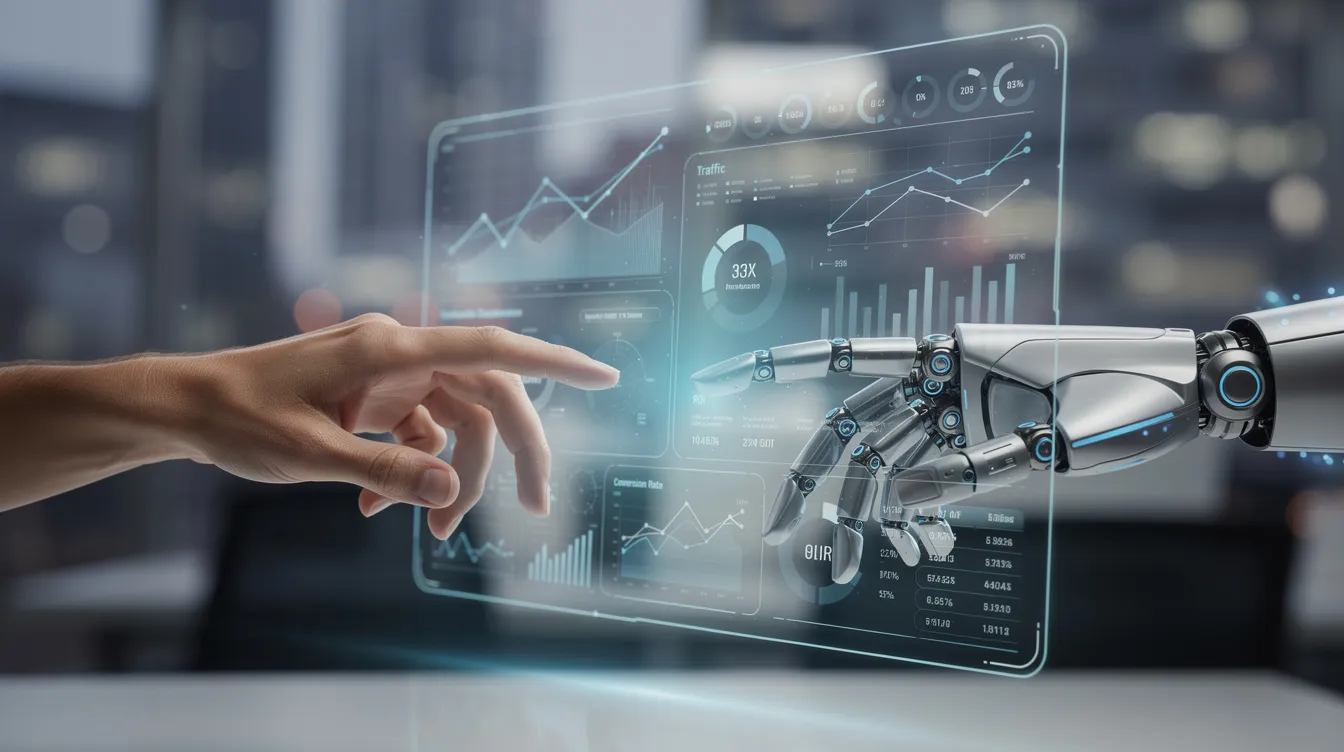
What AI Really Brings to Digital Marketing Today
AI is no longer experimental. It underpins most modern ad platforms and marketing automation tools that marketing teams use daily. Google Performance Max uses machine learning to allocate budgets and generate ad variations. Meta Advantage+ automates audience targeting. Email platforms run predictive lead scoring and send-time optimization behind the scenes.
Here's what artificial intelligence concretely enables marketers to do in 2026:
- Process data at scale: AI can analyze vast amounts of data quickly - about 2.9 times faster than humans, according to multiple benchmarks. AI can analyze large datasets 2.9 times faster than humans, surfacing patterns from millions of impressions that human workers would take weeks to compute.
- Personalize at volume: 87% of marketers report improved personalization from AI, using behavior signals, purchase history, and predictive LTV models to tailor content.
- Eliminate workflow friction: AI marketing automation eliminates bottlenecks in workflow execution, from bid management to dynamic content assembly.
- Collaborate, not just execute: AI serves as a collaborator enhancing precision, efficiency, and scale in marketing - not just a content generator, but a system for data analysis, customer segmentation, and campaign performance optimization.
The ai vs human discussion must start from this reality: AI is already inside the stack. It's not an optional add-on.
Speed and Scale: Where AI Outruns Human Marketers
AI's biggest advantage is speed and scalability. AI marketing excels at rapid scaling and cost efficiency across every channel.
Consider these capabilities:
- Data processing: AI can analyze data 2.9 times faster than humans. A year of Meta or Google ad data - millions of impressions and clicks - gets parsed in seconds to surface actionable insights human beings would miss entirely. Humans cannot analyze massive datasets as effectively as AI can.
- Content generation: AI can generate multiple content variations in seconds for high-volume campaigns. Need 200 subject lines for an email test? AI tools deliver them in minutes. AI can quickly create initial concepts for client feedback, enabling faster approval cycles.
- Ad optimization: AI can identify trends and instantly optimize ad placements, reallocating spend toward top-performing creatives without waiting for a human to pull a report.
- Personalization at scale: Optifai's study of 939 B2B companies found that hyper-personalized subject lines achieved ~42% open rates vs ~12% for generic ones - a gap only achievable through AI-powered data quickly processed and applied across tens of thousands of contacts.
One striking example: Volvo created a video ad made entirely by AI content - never even showing the car - and it achieved over 850 million impressions. The scale and speed were only possible because AI handled the heavy lifting of content production and distribution.
Where Human Creativity Still Wins (and Why It Matters)
Now the pivot. For all AI's strengths, human imagination and emotional intelligence remain irreplaceable in creativity in marketing.
Humans excel at understanding broader market context and brand identity. They understand cultural nuances vital for nuanced branding. They're better suited for crafting emotionally resonant narratives - the kind that define brands for decades. Human creativity is superior at creating ads that resonate emotionally, and human creatives craft narratives that resonate deeply with audiences because they understand desires and pain points crucial for brand storytelling.
AI lacks emotional intelligence and cultural context in marketing. It can't fully grasp sarcasm, navigate taboo topics, or read shifting cultural sentiment. AI generated content may lack originality and emotional depth, and human marketers maintain brand identity and tone more effectively than AI.
Consider the evidence:
- Coca-Cola's "Share a Coke" campaign was driven by human insight - the idea that seeing your own name on a bottle creates personal connection. No algorithm proposed that.
- Dove's "Real Beauty" campaign succeeded because human beings understood body image politics. AI would have flagged it as risky.
- In 2026 Big Game ads, System1 found that emotionally grounded, human-story ads outperformed AI-referencing tech ads, which averaged just 2.1 Stars in emotional ratings.
Human creativity excels in emotional storytelling and innovation. Human creativity excels in crafting emotionally resonant campaigns. The emotional stories, strong emotions, and emotional triggers that move people to act still come from the human element - from human insight and strategic thinking about what audiences actually need to hear.
Head-to-Head: AI vs Human Creativity in Ads
Let's get specific about advertising. Where does each side actually win?
Where AI excels in ads:
- Rapid iteration of visuals and copy - automatic cropping, resizing, format adjustments
- Performance-based optimization of headlines and CTAs using ai algorithms trained on user behavior
- Smart targeting based on lookalike audiences
- AI driven personalization boosts engagement by 25 percent in campaigns that use behavioral targeting
Where humans win in ads:
- Big creative concepts, humor, satire, and value-driven messages
- Brand consistency across campaigns and channels - maintaining brand integrity and brand authenticity
- Cultural sensitivity on politically or socially charged topics
- Creative direction that breaks patterns rather than following them
Human-led campaigns outperform AI-only efforts in driving short-term sales, largely because human expertise brings emotional depth that algorithms can't replicate. At the same time, consumers are often skeptical of AI-generated content, making human oversight critical for trust.
The risk of leaning too hard on AI? TechRadar reported that AI-generated ads are becoming indistinguishable from each other - a homogeneity problem that erodes brand identity.
Practical Workflow: Co-Creating Ad Campaigns with AI
Stop comparing abstractly. Here's how marketing teams actually combine AI and human creativity when creating campaigns:
- Humans define campaign strategy, target audiences, and brand guardrails
- AI suggests audiences, angles, and generates multiple variations of hooks and primary text
- Humans refine core creative concepts and set creative direction
- AI produces visual moodboards, resizes assets, and runs multivariate tests
- Humans approve final assets - human judgment decides what ships, what stays in testing, and what never goes live
Using humans for strategy and AI for optimization often yields the best results. AI is best used for data-driven tasks while humans provide narrative direction. This hybrid approach can increase campaign recall by up to 31%, proving that co creation outperforms either approach alone.

AI vs Human in Email Marketing: From Subject Line to Signature
Email remains one of the highest-ROI channels in digital marketing. It's also where the ai vs human debate plays out most measurably.
Where AI wins in email:
- AI excels at personalizing email content at scale - subject lines, content blocks, product recommendations
- Optimizing send frequency and timing based on individual open patterns
- Cleaning and scoring lists using machine learning models
- Mailercloud's study of 50,000 emails showed AI subject lines drove 14.3% higher open rates than human-written ones when given full context prompts
- AI improves personalization efforts for 87% of marketers
Where humans win in email:
- Defining the email program's narrative arc - welcome journeys, launch sequences, reactivation emotional stories
- Writing emotionally resonant copy that reflects brand voice
- Creating personalized content takes time, limiting volume production - but human touch produces deeper connection
- The Mailercloud study also found human-written body copy led to ~6.2% higher click-through rates, with readers noting more warmth
Companies using AI see revenue uplifts of 5 to 15 percent in email programs. But the biggest wins come from the hybrid approach: AI subject lines combined with human body copy and AI-optimized CTAs beat both pure human and pure AI campaigns by approximately 23.4% across all metrics.
Designing High-Converting Email Sequences with AI and Human Creativity
Here's a blueprint for a 5–7 email product launch funnel using both ai tools and human input:
Role | AI Tasks | Human Tasks |
|---|---|---|
Segmentation | Map behavior-based segments, score leads | Define strategic audience tiers |
Timing | Propose optimal send times per segment | Set campaign calendar and pacing |
Copy | Draft first-pass subject lines, preview text, CTA options | Set core story arc (problem → tension → solution → proof), edit for voice |
Personalization | Insert tokens based on purchase/browse history | Review for clickbait, off-brand humor, misaligned promises |
Testing | Run multivariate tests on subject lines and CTAs | Interpret results, decide strategic pivots |
AI can automate repetitive tasks, freeing humans for creativity - the high-impact creative work of shaping emotional beats and ensuring brand authenticity. Companies using AI-powered predictive analytics have seen a 2.9x increase in ROI. AI tools can improve campaign ROI by 2.9 times when paired with human strategic oversight. Automated email flows in industry benchmarks drive approximately 320% more revenue than standard batch sends.
Funnels and Customer Journeys: Strategy Still Belongs to Humans
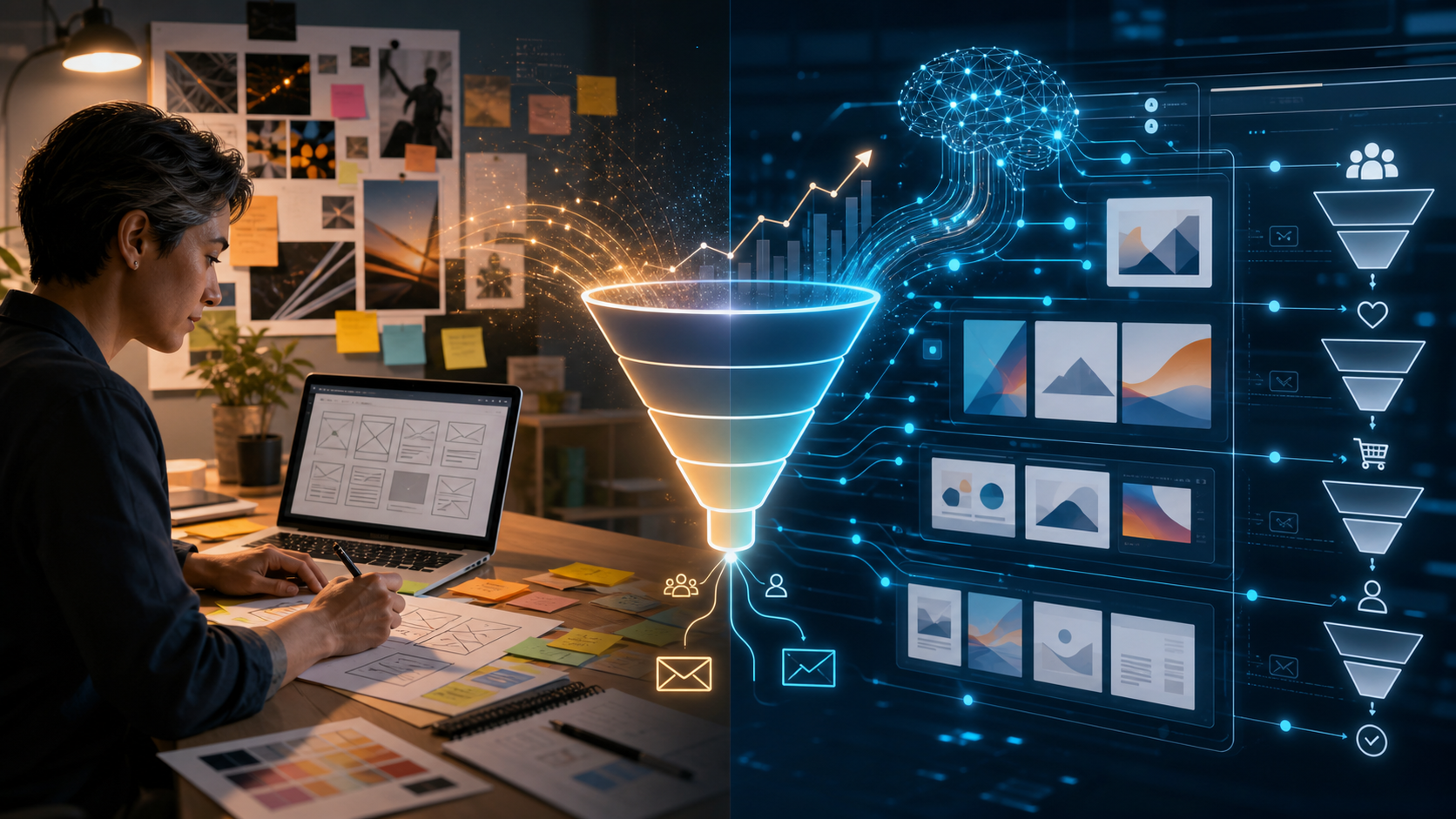
A funnel is the full path from first ad impression to repeat purchase and referral. AI helps optimize each step. Humans must own the architecture.
How AI contributes:
- Predictive lead scoring in CRMs assigns probabilities based on firmographic and behavioral data, driving 25–40% conversion lifts when high-score leads are routed promptly
- Automated nurture paths triggered by lifecycle stage
- On-site personalization of landing pages using recommended next-best-offer models
Where human expertise must lead:
- Humans are better at defining marketing strategy and understanding the why behind each funnel stage
- Mapping the customer journey requires understanding offline realities, pricing psychology, and cultural context
- Developing high-quality creative content takes significant time, but it's what differentiates funnel experiences
- Human creativity excels in crafting emotionally resonant campaigns at top-of-funnel awareness stages
Employing skilled individuals requires larger financial investment, but the ROI of human-led funnel design compounds over time through stronger brand positioning and customer interactions.
Using Actionable AI Insights Without Losing Strategic Control
AI tools can flag underperforming steps - for example, a 40% drop-off after the pricing page - and propose fixes like adding social proof or an FAQ section. But human judgment decides which trade-offs to accept.
Set up a regular review rhythm: weekly or monthly, marketing teams examine AI dashboards and translate data into strategic experiments instead of blindly applying suggestions. AI marketing tools can improve ROI by 2.9 times, but only under human supervision that prevents chasing short-term clicks at the expense of long-term brand equity.
The risk of surrendering full control? Over-optimization can erode brand distinctiveness and alienate loyal customers who value authenticity.
Can AI Replace Human Creativity in Marketing? A 2026 Verdict
Here's the direct answer: AI won't replace human creativity in marketing. It will replace many purely executional and time consuming tasks, forcing human workers to move up the value chain into strategy, insight, and high-level creative direction.
Key limits of AI:
- AI relies on historical data, making true innovation from new ideas difficult
- AI lacks emotional intelligence and cultural context
- Risk of homogenized outputs when everyone uses similar prompts - ai lacks the ability to deliberately break patterns
Key limits of humans:
- Slower data analysis and capacity constraints
- Bias and guesswork without data support
- Inconsistent execution across hundreds of assets
The key differences between AI and humans aren't about which is "better." They're about which tasks each handles best. Teams that thrive redesign their processes so ai and human creativity are interdependent. Human efforts focus on brand storytelling, emotional depth, and strategic thinking. AI handles speed, scale, and optimize campaigns through data-driven iteration.
Designing an AI + Human Co-Creation Playbook
Turn theory into a repeatable playbook for your next campaign:
Phase 1: Discover
- AI mines performance data, audience signals, and competitor patterns
- Humans interpret insights and define strategic opportunities
Phase 2: Create
- AI drafts and prototypes - generating headlines, visuals, email copy at volume
- Humans shape the core idea, set emotional beats, and ensure brand voice integrity
Phase 3: Optimize
- AI runs tests across multiple variations, scores leads, and adjusts targeting
- Humans judge results, adjust marketing strategies, and decide when to scale or pivot
Document guardrails: tone guidelines, off-limit topics, minimum human review standards before publishing, and data privacy requirements. AI helps accelerate every phase, but human input ensures the output reflects who your brand actually is.
Start one co-created campaign this quarter. Measure it against your legacy workflow. That single experiment will tell you more than any article can.
Future Trends: How AI and Human Creativity Will Evolve in Marketing
Looking from 2026 to 2030, several trends are shaping the future:
- Multimodal AI combining text, image, video, and audio will produce fully integrated creatives, making content production faster and more accessible
- Context-aware models will improve at reading cultural nuance, but will still need human oversight for sensitive topics
- Regulation is tightening - the EU AI Act and evolving privacy rules will require disclosure of AI usage and ethical guardrails
- Consumer expectations are rising: audiences will increasingly value brand authenticity and penalize overtly robotic, generic messaging
The future isn't ai vs human. It's ongoing co creation. Marketing teams that embrace continuous learning around AI - developing skills in prompting, evaluating outputs, and translating ai-generated analytics into real experiments - will hold a significant competitive advantage. The roles of human marketers will evolve toward orchestration, brand stewardship, and cross-channel creative leadership.
FAQ
Will AI fully replace copywriters and designers in digital marketing?
By 2026, AI can create decent first drafts of ads, emails, and landing pages - but brands that rely solely on AI risk generic, off-brand, or culturally tone-deaf content. Human creatives are shifting into roles like concept development, brand voice guardianship, and quality control over AI outputs. AI will replace some time consuming tasks, not entire creative professions. The marketers who actively learn to leverage ai tools will be the most valuable.
How can small businesses use AI without losing their unique brand voice?
Start by training AI tools with your existing best content - past emails, winning ads, and social posts - to give the model examples of your tone. Use AI to brainstorm and draft, but always edit outputs manually to reinsert personality, local references, and brand-specific phrases. Set simple internal rules: no AI text goes live without human review, and sensitive topics like pricing changes or crisis communications are written by humans only.
What skills should marketers develop to stay relevant in an AI-driven world?
Deepen skills in strategic thinking, customer research, creative concepting, and data interpretation rather than manual production tasks. Learn to prompt and evaluate AI effectively - knowing how to critique outputs and convert AI insights into real experiments. Soft skills that AI cannot replicate remain essential: empathy, negotiation, stakeholder management, and the ability to align creative work with business goals.
Are there risks in letting AI handle most of my ad and email decisions?
Key risks include over-optimization for clicks at the expense of brand trust, potential bias or cultural insensitivity in outputs, and erosion of distinctiveness if everyone uses similar AI prompts. Implement guardrails: human review of top creatives, periodic brand audits, and clear content rules. Blind trust in platform automation can hide campaign performance issues or misaligned messaging until they cause real damage. AI is safest when treated as a powerful assistant, not an unsupervised decision-maker.
How do I measure whether AI is actually improving my marketing?
Set up A/B tests where AI-assisted campaigns run against purely human-created baselines for 4–6 weeks. Track specific metrics by channel: for ads, CTR, CPC, and ROAS; for email, open rate, click rate, and revenue per subscriber; for funnels, conversion rates at each step. Look beyond surface metrics to long-term indicators like unsubscribe rates, brand search volume, and repeat purchase behavior. Document AI's impact over several campaigns to build internal confidence and refine how your team uses both ai and human creativity going forward.
Your Friend,
Wade